
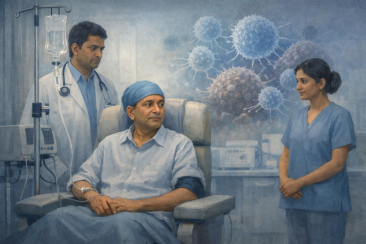
When Imran’s blood cancer returned after years of treatment, the options before him were running out.
First diagnosed in 2008, Imran had already undergone multiple rounds of chemotherapy and a bone marrow transplant for leukaemia. The procedure was punishing, and within 18 months the disease relapsed again. After discussing available treatment options with his physicians, Imran was evaluated for CAR-T therapy.
Doctors mentioned CAR-T therapy, among the most advanced tools in modern oncology. But globally, the treatment typically costs ₹3 crore to ₹4 crore per patient, effectively placing it outside the reach of most families in emerging healthcare systems.
That equation began to shift in October 2023, when Mumbai-based biotechnology company ImmunoACT received approval for India’s first indigenous CAR-T therapy. Clinicians say the all-in patient cost is a fraction of global CAR-T therapies, including hospitalisation and supportive care. Early uptake has been encouraging, but the longer term test is still ahead: whether outcomes, manufacturing consistency and payment mechanisms hold up as use expands beyond early centres.
For India, that price gap is more than a commercial detail. It is an early test of whether complex cell therapies can be adapted to the economics of a resource-constrained healthcare system.
CAR-T, or chimeric antigen receptor T-cell therapy, involves extracting a patient’s immune cells, genetically engineering them to recognise cancer, and reinfusing them into the body. It is scientifically sophisticated, but the bigger challenge is industrial. Unlike conventional drugs manufactured in bulk, each CAR-T dose is individually produced from a patient’s own cells.
That makes manufacturing reliability central to the business model.
ImmunoACT says it has capacity to deliver 3,000 infusions a year, with a manufacturing failure rate of about 1% and a vein-to-vein turnaround time of 18 days. In cell therapy, those numbers matter. A failed batch is not a supply-chain inconvenience; it can mean lost time for a patient with an aggressive cancer.
The delivery network is also widening. More than 600 patients have been treated so far, according to company-reported data. More than 90 centres across India — including private hospitals as well as government hospitals and centres — have been onboarded, extending access beyond a few elite metropolitan institutions into tier-1 and tier-2 cities. Those numbers indicate early traction, though independent long-term data on durability, affordability and broad real-world access are still limited.
That is important because cell therapy does not scale on factory output alone. Hospitals need trained teams, transplant capability, monitoring infrastructure and the ability to manage immune-related complications quickly.
The broader significance lies beyond one product. India built global scale first in generics and then in biosimilars by mastering cost-efficient manufacturing. CAR-T is a harder frontier. Here, each batch is a living product, not a standardised vial.
That is why indigenous CAR-T is also a policy story.
Even at a fraction of global cost, the therapy remains expensive by Indian standards. At Indian income levels, one-tenth of global cost is still not mass affordability; without reimbursement support, it remains beyond the reach of most families. The company says it is exploring partnerships to expand patient access through patient support programs such as The Hope Initiative.
The next question is whether insurers and public programmes will pay. Traditional procurement systems tend to reward the lowest upfront price. But one-time therapies such as CAR-T challenge that logic. Health Technology Assessment frameworks try to evaluate therapies on broader value — not just acquisition cost, but long-term outcomes and downstream system savings. That shifts the debate from lowest price to best value,
a distinction that becomes critical when one-time therapies such as CAR-T challenge procurement systems designed for repeated cycles of care.
The larger question is whether India can build an economic model for therapies that are both technologically complex and financially disruptive.
If payers recognise the value of one-time curative-intent treatments, CAR-T could mark the beginning of India’s cell-therapy industry. If they do not, the science may advance faster than access.
Imran has been in remission for over two years now. For patients like him, the impact is clear: the fight continues, but now there is hope.
Note: CAR-T therapy may cause side effects that are severe or life-threatening and requires administration in specialised centres with trained teams and appropriate monitoring. Patients should consult their treating physicians to understand the full risk benefit profile before considering therapy.
The article is written for knowledge and educational purposes. The contents of the article reflect the author’s personal views alone and has nothing do with the company, healthcare professionals, or healthcare organisations.
