
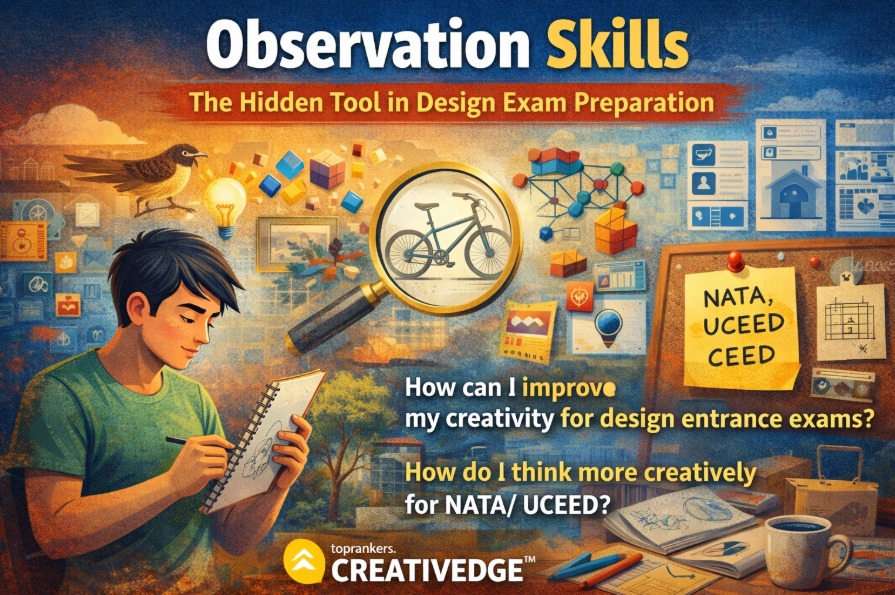
In a world increasingly driven by creativity and visual thinking, design entrance exams like NATA, UCEED, and CEED have become gateways to some of India’s most prestigious design institutes. With thousands of aspirants competing every year for limited seats in institutions like IITs, NIDs, and top architecture colleges, the question is no longer just about talent—it is about how effectively students can observe, interpret, and translate the world around them.
According to experts at Creative Edge by Toprankers, one of the leading platforms for design preparation in India, observation skills are often the most underrated yet powerful tool in cracking design entrance exams.
“Students believe creativity is something you’re born with. In reality, creativity is something you train—and observation is where that training begins,” says a senior mentor at Creative Edge by Toprankers.
Why Observation Matters More Than Talent
Design exams are not just about drawing skills or imagination. They test how well a student can:
- Understand real-world objects and environments
- Analyse shapes, proportions, and perspectives
- Translate ideas visually with clarity
- Solve problems creatively
In exams like UCEED and CEED, the focus is heavily on visualisation, logical reasoning, and design aptitude, while NATA evaluates spatial ability, perspective drawing, and aesthetic sensitivity.
Data from past exam trends shows that students who perform well are not necessarily the best artists—but those who can observe details accurately and apply them creatively.
This is where observation becomes a game-changer.
The Science Behind Observation and Creativity
Observation is not passive—it is an active cognitive process.
When students observe closely, they:
- Notice patterns and structures
- Understand relationships between objects
- Develop spatial awareness
- Build visual memory
Research in cognitive psychology suggests that creative thinking improves when individuals engage deeply with their surroundings, rather than relying only on imagination.
“Creativity is not about creating something out of nothing. It is about connecting what you see with what you know,” explains an expert at Creative Edge by Toprankers.
How Can I Improve My Creativity for Design Entrance Exams?
This is one of the most common questions among students who feel they are “not creative enough.”
According to mentors at Creative Edge by Toprankers, creativity is not a fixed trait—it is a skill that can be developed with consistent practice.
Here’s how students can improve their creativity:
1. Train Your Observation Daily
Start noticing everyday objects—chairs, buildings, shadows, textures. Ask yourself: Why does it look this way? How can it be redesigned?
2. Maintain a Visual Diary
Sketch what you see daily. It doesn’t have to be perfect. The goal is to improve your ability to capture details.
3. Break Objects into Basic Shapes
Design exams often test your ability to simplify complex objects into basic forms like cubes, cylinders, and spheres.
4. Explore Different Perspectives
Look at the same object from multiple angles. This improves spatial understanding, which is crucial for exams like NATA.
5. Solve Previous Year Questions
Past papers help you understand how observation translates into exam questions.
6. Engage with Design Around You
From product packaging to architecture—analyse design in everyday life.
Students enrolled in structured programs at Creative Edge by Toprankers often report significant improvement in creativity because of guided exercises that focus on observation and application.
How Do I Think More Creatively for NATA/UCEED?
Thinking creatively is less about sudden inspiration and more about training your brain to see possibilities.
Experts at Creative Edge by Toprankers suggest the following approach:
- Think in Alternatives
Instead of accepting things as they are, ask: What else could this be?
- Combine Unrelated Ideas
Innovation often comes from combining two different concepts—like nature and technology.
- Practice Visualization
Close your eyes and imagine transforming an object—changing its function, shape, or scale.
- Focus on Problem-Solving
Design exams often test creativity through problem-solving scenarios. Train yourself to think of practical and innovative solutions.
- Limit Overthinking
Many students struggle because they try to be “perfect.” Creativity flows better when you allow yourself to experiment.
“Creative thinking is a habit. The more you practice it, the more natural it becomes,” say experts at Creative Edge by Toprankers.
The Reality of Design Entrance Exams
Every year, thousands of students appear for exams like NATA and UCEED, but only a small percentage secure admission into top colleges.
NATA is conducted multiple times a year, with students aiming for top architecture colleges
UCEED sees intense competition for IIT seats
CEED attracts design graduates aiming for advanced programs
This level of competition means that students need more than just theoretical preparation—they need practical, observation-driven skills.
Interestingly, students who rely only on theory or memorisation often struggle in sections that require visual interpretation and creative application.
Bridging the Gap: From Observation to Performance
One of the biggest challenges students face is translating what they observe into what they draw or design.
At Creative Edge by Toprankers, the focus is on bridging this gap.
Their preparation approach includes:
- Structured observation exercises
- Drawing and visualisation training
- Real exam-level practice questions
- Personalised feedback from mentors
This ensures that students not only observe better but also apply their observations effectively in exams.
For many aspirants, especially those exploring design entrance exam coaching, this structured approach becomes crucial in building confidence and clarity.
Breaking the Myth: “I Am Not Creative Enough”
A large number of students hesitate to pursue design because they believe they are not creative.
Experts strongly disagree.
“Creativity is not about being extraordinary. It is about being attentive, curious, and consistent,” says a mentor at Creative Edge by Toprankers.
Students who develop observation skills often realise that creativity was never missing—it just needed direction.
Conclusion: Observation is the Foundation of Design Success
Design exams are evolving. They are no longer about just drawing—they are about thinking, analysing, and solving.
And at the heart of all these skills lies one fundamental ability: observation.
For every NATA, UCEED, or CEED aspirant, the takeaway is clear:
- Observe more
- Think deeper
- Practice consistently
Because in the world of design, what you see—and how you see it—can define your success.
As experts at Creative Edge by Toprankers emphasise, observation is not just a skill—it is the starting point of creativity itself.
