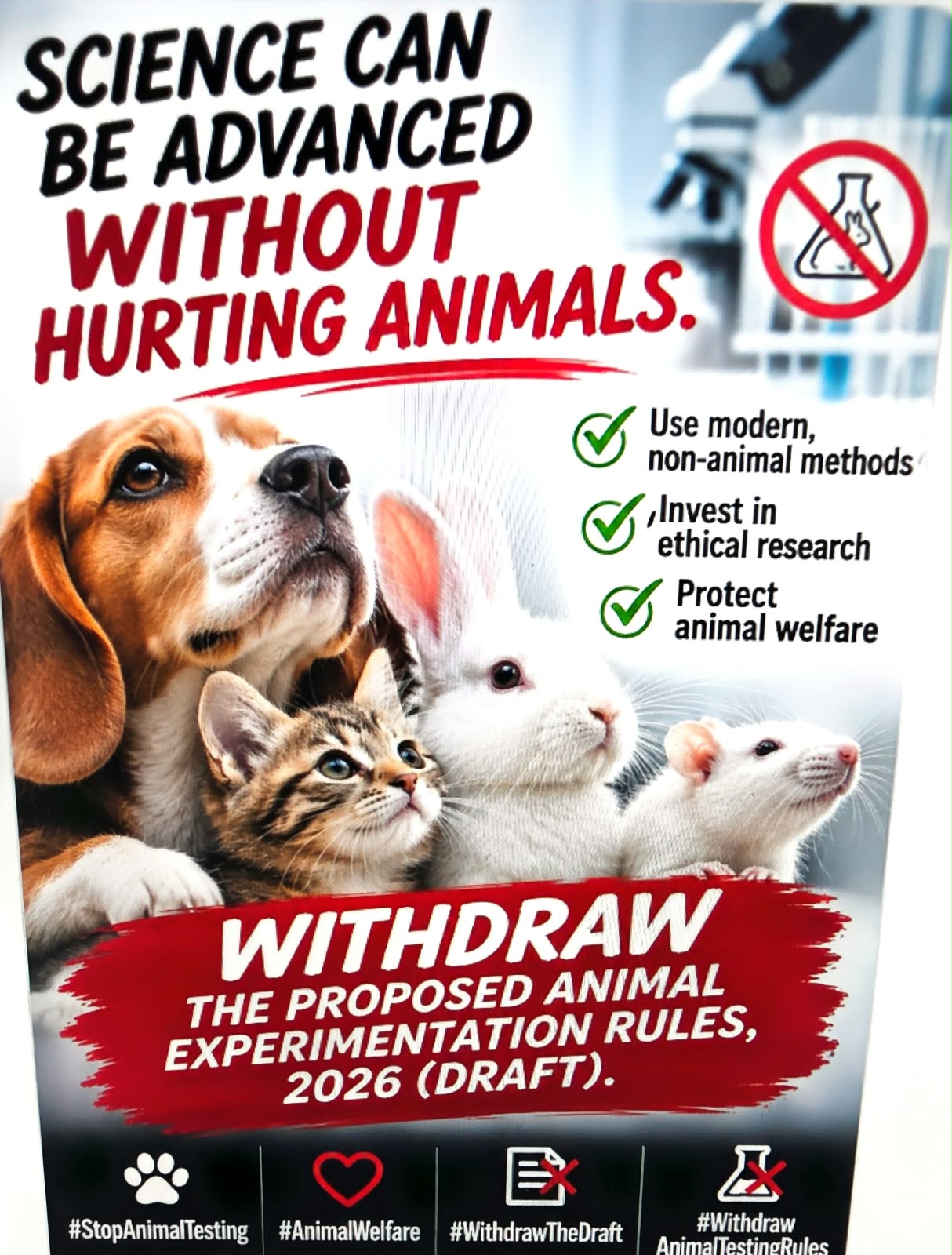
New Delhi [India], November 3: Prominent animal welfare organisations, scientific experts and advocacy groups have voiced strong opposition to the Draft Prevention of Cruelty to Animals (Control and Supervision of Experiment, Breeding and Trading of Laboratory Animals) Rules, 2026, issued by the Ministry of Fisheries, Animal Husbandry and Dairying on October 6, 2026. Critics argue that the proposed framework drastically dilutes existing protections and marks a dangerous step backward for both ethical standards and scientific modernisation in India.
Among the key concerns raised are provisions that would open the door to using stray and wild animals in laboratories — sources that have so far been off-limits, with laboratory animals required to come from registered breeders — and a shift towards institutions approving their own experiments with reduced independent, third-party scrutiny.
Would we accept this for ourselves?
Rakhi Arora from East Delhi strongly challenged the ethics of the proposed rules, asking whether human beings would ever agree to undergo similar testing, even under strict regulation. If such a concept is inherently unacceptable for humans, she questioned how animals could ever justly be subjected to cruel and painful experiments.
A call to embrace modern, human-relevant science
"We urge lawmakers to amend or withdraw the current regressive draft rules, increase funding for alternative technologies, train scientists, doctors and veterinarians in these methods, and establish a clear timeline for phasing out animal testing," said Swasha of Jeevraksha. "The entire world has surged ahead. Progressive science and humanity must go hand in hand. We are in 2026 — modern science now relies on New Approach Methodologies (NAMs) and the 3Rs framework of Replacement, Reduction and Refinement to substitute or replace animal testing."
Swasha pointed to proven alternatives that are already transforming research worldwide, including:
- In vitro methods — studies using human cells and tissues
- In silico modelling — computer simulations and AI-driven prediction
- In chemico methods — molecular and biochemical testing
- Human-centric clinical approaches — research grounded directly in human biology and patient data
A rubber stamp for exploitation
Raising serious legal and oversight concerns, Advocate Tapish Damley said, "By legalising the capture of vulnerable stray and wild animals for testing and allowing laboratories to police their own cruelty, the 2026 Rules effectively turn independent ethical oversight into a rubber stamp for exploitation."
The demands
The signatories are calling on the Ministry of Fisheries, Animal Husbandry and Dairying and the Committee for Control and Supervision of Experiments on Animals (CCSEA) to:
1.Amend or withdraw the Draft Rules, 2026 in their present form
2.Prohibit the use of stray, community and wild animals in experiments
3.Retain strong, independent oversight of all animal experimentation
4.Increase public funding for non-animal research methods and NAMs
5.Train scientists, doctors and veterinarians in alternative technologies
6.Set a clear, time-bound roadmap for phasing out animal testing
The groups stressed that India has an opportunity to lead in ethical, human-relevant science and that the final rules must strengthen, not weaken, the protections guaranteed under the Prevention of Cruelty to Animals Act, 1960.
Click here: https://tinyurl.com/4y9z92yy